Top 60 Traditional Japanese Foods You’ll Regret Never Experiencing in Their Authentic Form

The first time I ate Japanese food, I didn’t know how to describe what I was tasting.
There was nothing familiar to compare it to. No spice level to judge or comfort flavor to fall back on.
It felt oddly vulnerable, like being a baby tasting something new for the first time. Somewhere in that quiet space, I met umami, the fifth taste, and realized I had been eating food my whole life without fully understanding it.
That moment stayed with me.
Traditional Japanese Foods have a way of doing that. They’re layered, intentional, and surprisingly emotional, much like a Christopher Nolan film. On the surface, everything feels simple. But sit with it long enough, and you realize how much thought lives beneath every choice.
Nothing on the plate is accidental. Every ingredient has a purpose. Every technique has a reason. And every dish trusts you enough to slow down and meet it halfway.
This blog isn’t a list meant to skim. It’s an invitation to experience Japanese cuisine the way it was designed; patiently, thoughtfully, and with attention to detail.
Top 60 Best Traditional Japanese Foods for You to Try this Year
We have organized this list to serve as your roadmap, starting with the “heavy hitters,” those world-famous icons that form the backbone of the culture, before we dive into the more rustic, regional secrets you won’t find on a standard tourist menu. Every dish here earned its spot based on its deep history and how much it actually represents the Japanese spirit.
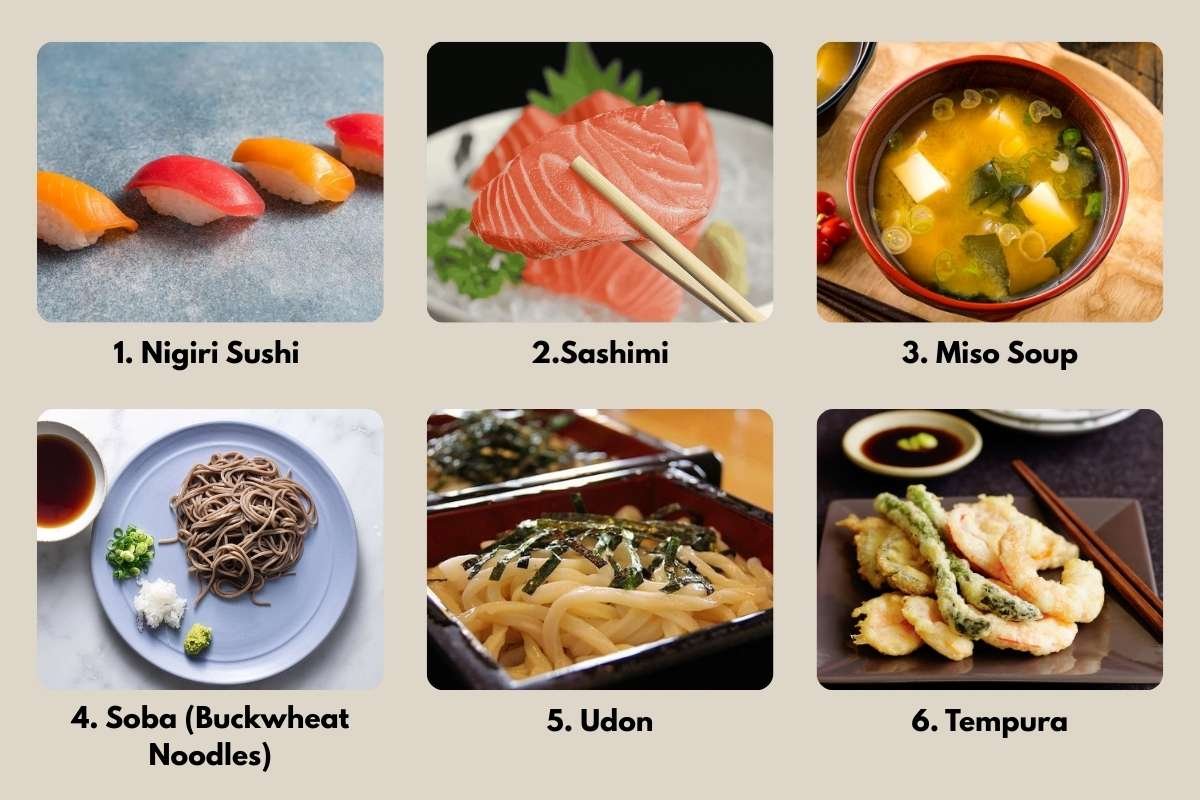
1. Nigiri Sushi
Nigiri represents the absolute pinnacle of culinary precision. A master chef spends years perfecting the “shari” (vinegared rice) before they ever touch the fish. The goal is a delicate balance where the rice is body-temperature, and the fish is pristinely fresh. You should experience a melting sensation as the fat of the fish integrates with the acidic rice.
- Best Place: Sukiyabashi Jiro (Tokyo) – The legendary three-star temple of sushi.
- Ingredients: Seasoned rice, wasabi, and seasonal seafood like O-toro (fatty tuna).
- Pro Tip: Turn the piece upside down to dip the fish into soy sauce; never soak the rice.
2. Sashimi
Sashimi strips away every distraction to focus on the raw quality of the ocean’s bounty. This dish consists of thinly sliced raw seafood served without rice. Chefs use specific knives, like the Yanagiba, to slice through the fibers of the fish without bruising the flesh, ensuring a clean and silky texture on the palate.
- Best Place: Kanazawa Omicho Market – Famous for cold-water snapper and shrimp.
- Ingredients: Raw fish, shredded daikon, and shiso leaves.
- Pro Tip: Use a tiny amount of wasabi directly on the fish rather than mixing it into your soy sauce.
3. Miso Soup
Miso soup serves as the cornerstone of every Japanese breakfast. It is a fermented powerhouse that supports gut health through probiotics. The base is always dashi, which provides the essential mineral content. Unlike heavy Western soups, miso soup is light, restorative, and designed to prime the digestive system for the day ahead.
- Best Place: Any Ryokan (traditional inn) in Kyoto.
- Ingredients: Miso paste, dashi, tofu, and wakame seaweed.
- Pro Tip: Never boil the miso paste, as high heat kills the healthy active cultures.
4. Soba (Buckwheat Noodles)
Soba offers a nutty, earthy depth that regular wheat noodles just can’t touch. As a standout among Traditional Japanese Foods, it’s made from buckwheat flour and loaded with rutin, an antioxidant that’s great for your heart. Just a heads-up: while buckwheat itself is gluten-free, traditional shops usually mix in a little wheat to get that perfect “bite.” Whether you’re slurping them cold off a bamboo mat or hot from a steaming bowl, these noodles are the ultimate everyday fuel.
- Best Place: Honmura An (Tokyo) – Renowned for hand-rolled buckwheat.
- Ingredients: Buckwheat flour, water, and dashi-based dipping sauce.
- Pro Tip: Slurping your noodles is encouraged; it aerates the broth and enhances the flavor.
5. Udon
Udon is the “comfort food” of the noodle world. These thick, chewy wheat noodles provide a satisfying texture that absorbs the flavors of the surrounding broth. In regions like Kagawa, udon is a way of life, with locals eating it for breakfast, lunch, and dinner to sustain their energy during physical labor.
- Best Place: Sanuki Udon (Kagawa Prefecture) – The holy grail for udon lovers.
- Ingredients: Wheat flour, salt, and water.
- Pro Tip: Try “Kitsune Udon,” which features a sweet, deep-fried tofu pouch on top.
6. Tempura
While deep-frying sounds modern, the Japanese perfected this technique in the 16th century. Authentic tempura uses a cold batter and high-quality sesame oil to create a coating so light it’s translucent. This method seals the moisture inside the vegetables or seafood, steaming the ingredient within its crispy golden shell for maximum tenderness.
- Best Place: Tempura Kondo (Ginza) – A masterclass in light, non-greasy frying.
- Ingredients: Flour, egg, ice water, and seasonal vegetables or shrimp.
- Pro Tip: Dip in tentsuyu sauce mixed with grated daikon to cut through the richness of the oil.
7. Yakitori
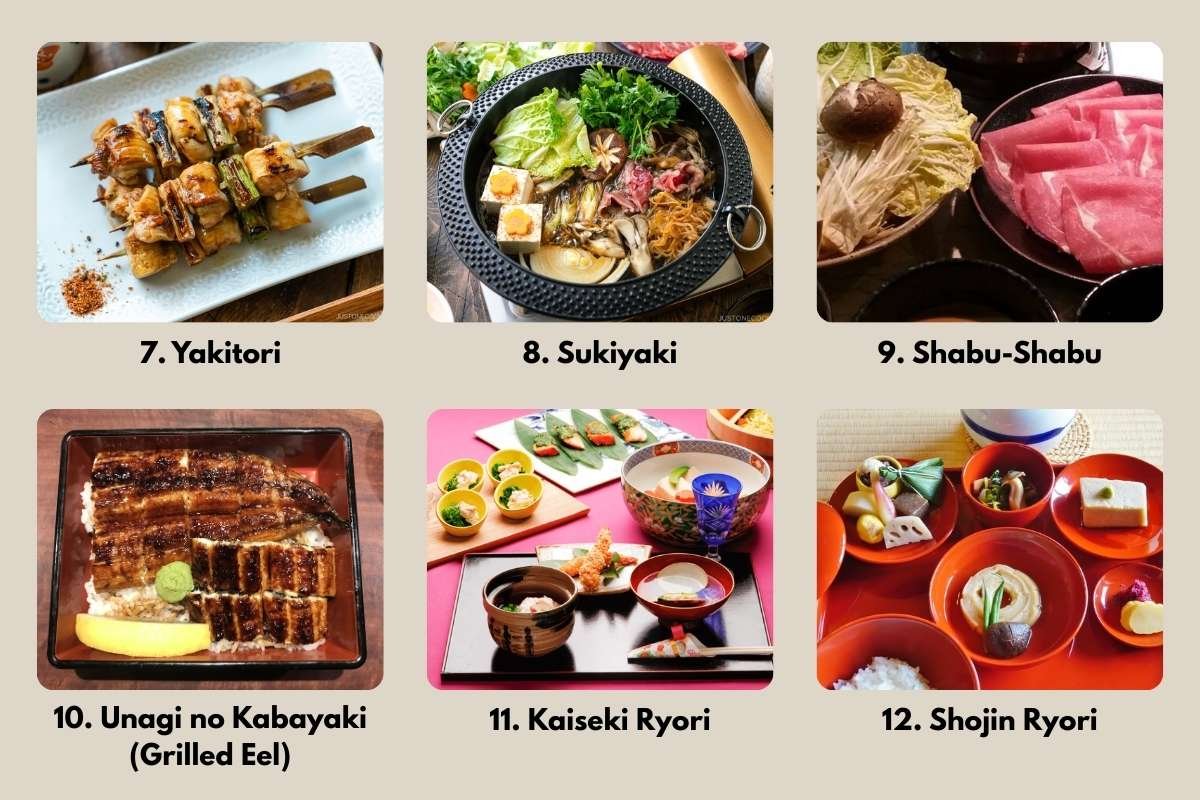
Yakitori is the art of the skewer. Every part of the chicken is used, from the breast to the heart and skin. Grilled over Binchotan (white charcoal), the meat acquires a smoky, clean flavor that gas grills cannot replicate. It is the quintessential social food, usually enjoyed with a cold beverage in a lively alleyway.
- Best Place: Memory Lane (Omoide Yokocho) in Shinjuku.
- Ingredients: Chicken, charcoal, salt (shio), or tare (sweet soy glaze).
- Pro Tip: Order “Omakase” to let the chef choose the best cuts of the day.
8. Sukiyaki
Sukiyaki is a communal hot-pot dish that defines winter luxury. It involves simmering high-quality beef in a shallow iron pot with a sweet and salty sauce. The experience is tactile and rich; once the beef is cooked, you dip it into a bowl of raw, beaten egg to add a creamy, cooling finish to the hot meat.
- Best Place: Mishima-tei (Kyoto) – A historic butcher shop and restaurant.
- Ingredients: Sliced beef, soy sauce, sugar, mirin, tofu, and leeks.
- Pro Tip: Add the vegetables after the meat to let them soak up the beef fat.
9. Shabu-Shabu
Similar to sukiyaki but lighter, Shabu-Shabu gets its name from the “swish-swish” sound the meat makes in the boiling broth. You cook the meat instantly in a kombu dashi, which preserves the natural flavor of the beef. This is an excellent choice for those seeking a high-protein, low-sugar version of Traditional Japanese Foods.
- Best Place: Imafuku (Tokyo) – For the highest grade Wagyu experience.
- Ingredients: Thin beef, kombu dashi, ponzu, and sesame sauce.
- Pro Tip: Don’t let the meat sit in the water; swish it until it just turns pink.
10. Unagi no Kabayaki (Grilled Eel)
Unagi is the ultimate stamina food. Rich in vitamins A and E, grilled freshwater eel is believed to help the body combat the grueling heat of Japanese summers. The eel is steamed to soften the bones and then grilled multiple times with a rich, caramelized soy glaze that creates a deeply savory crust.
- Best Place: Lake Hamana area (Shizuoka) – The capital of eel farming.
- Ingredients: Freshwater eel, soy sauce, mirin, and sugar.
- Pro Tip: Sprinkle some Sansho (Japanese pepper) on top to add a numbing, citrusy kick.
11. Kaiseki Ryori
Kaiseki is more than a meal; it is a multi-course edible poem. Originally served during tea ceremonies, it has evolved into the world’s most sophisticated tasting menu. Each course represents a specific cooking technique—steaming, grilling, simmering—and utilizes ingredients found in the immediate local environment during that specific week of the year.
- Best Place: Kikunoi (Kyoto) – Directed by master chef Yoshihiro Murata.
- Ingredients: Hyper-seasonal local vegetables, fish, and tofu.
- Pro Tip: Pay attention to the plates and bowls; they are often antiques chosen to match the season.
12. Shojin Ryori
This is the original vegan diet, perfected by Zen Buddhist monks. Shojin Ryori avoids meat and “pungent” vegetables like garlic or onions. Instead, it relies on the diverse textures of soybean products (tofu, yuba, natto) and wild mountain vegetables. It is designed to bring the mind and body into a state of meditative calm.
- Best Place: Shukubo (Temple Lodgings) in Mount Koya.
- Ingredients: Tofu, sesame seeds, seasonal roots, and seaweed.
- Pro Tip: Try “Goma-dofu” (sesame tofu), which is incredibly creamy and rich in healthy fats.
13. Onigiri (Rice Balls)
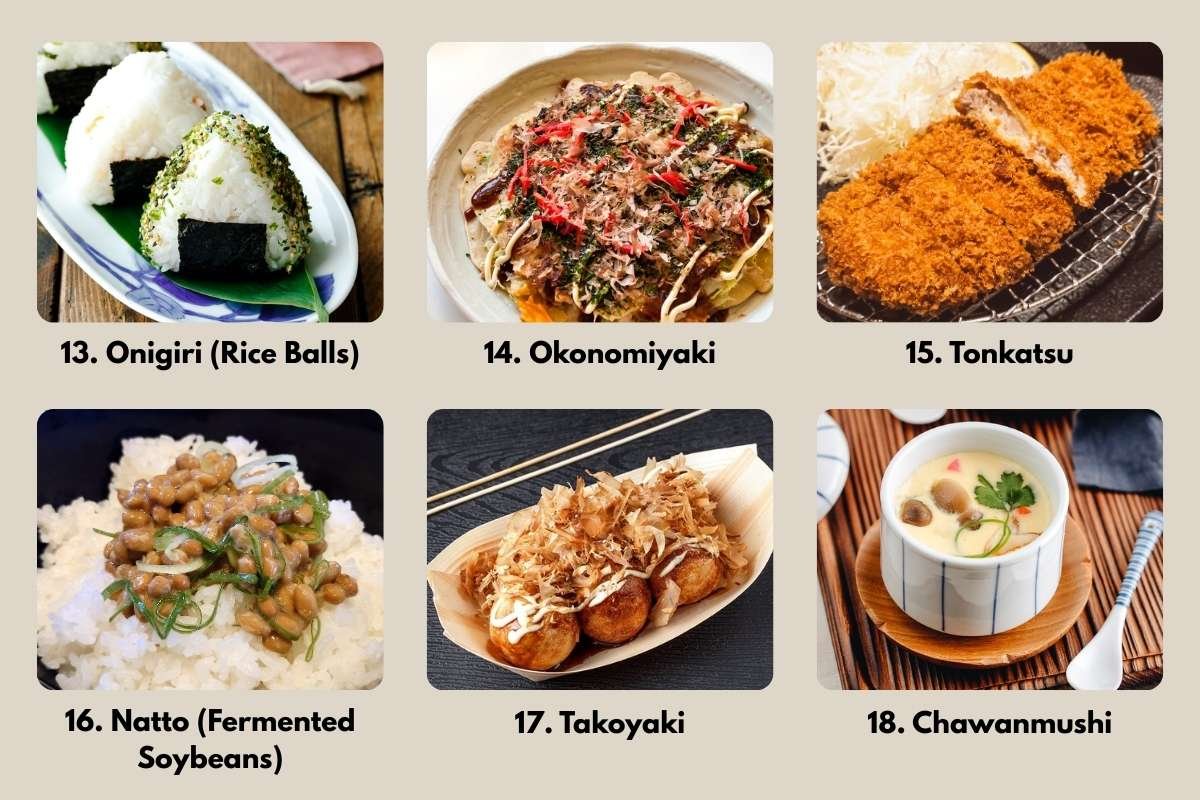
The ultimate Japanese “portable” food, Onigiri, has fueled samurai and school children for a thousand years. It is a simple triangle of rice with a salty filling, wrapped in a crisp sheet of nori. This dish proves that the most satisfying Traditional Japanese Foods often rely on just three or four high-quality ingredients.
- Best Place: Onigiri Bongo (Tokyo) – Famous for oversized, fluffy rice balls.
- Ingredients: Short-grain rice, nori, and fillings like salted salmon or pickled plum.
- Pro Tip: If buying from a convenience store, pull the tabs in order to keep the nori crispy.
14. Okonomiyaki
Often called a “Japanese savory pancake,” Okonomiyaki varies wildly between Osaka and Hiroshima. The base is a batter mixed with shredded cabbage and topped with pork belly. It is a dense, filling, and incredibly flavorful dish that reflects the “soul food” culture of the Kansai and Chugoku regions.
- Best Place: Okonomimura (Hiroshima) – A multi-story building dedicated only to this dish.
- Ingredients: Flour, cabbage, pork, okonomiyaki sauce, and mayonnaise.
- Pro Tip: In Hiroshima style, the ingredients are layered rather than mixed, and usually include noodles.
15. Tonkatsu
Tonkatsu is the king of Japanese comfort food. A thick pork cutlet is coated in “Panko”—large, airy breadcrumbs—and deep-fried to a shatteringly crisp texture. Despite the frying, the interior remains juicy and tender. It is traditionally served with a pile of finely shredded raw cabbage to aid digestion and balance the richness.
- Best Place: Tonkatsu Maisen (Aoyama, Tokyo).
- Ingredients: Pork loin or fillet, panko, egg, and tonkatsu sauce.
- Pro Tip: Use the “Karashi” (Japanese mustard) provided on the side for a spicy contrast.
16. Natto (Fermented Soybeans)
Natto is perhaps the most polarizing of all Traditional Japanese Foods. It is sticky, stringy, and has a strong fermented aroma. However, it is a nutritional miracle, containing Vitamin K2, which is essential for bone health. Most Japanese people eat it daily over rice as a vital health supplement disguised as a meal.
- Best Place: Mito (Ibaraki Prefecture) – The ancestral home of natto.
- Ingredients: Fermented soybeans, soy sauce, and karashi mustard.
- Pro Tip: Stir the beans vigorously at least 50 times to create the “umami strings” before eating.
17. Takoyaki
Takoyaki are small, spherical snacks that encapsulate the spirit of Osaka. These “octopus balls” are made of a wheat flour batter and cooked in a specialized molded pan. The exterior is golden and crisp, while the inside remains molten and creamy, punctuated by a chewy piece of octopus.
- Best Place: Dotonbori district in Osaka.
- Ingredients: Octopus, dashi batter, pickled ginger, and green onion.
- Pro Tip: Be careful—the inside is significantly hotter than the outside. Let them cool for a minute.
18. Chawanmushi
This savory egg custard is steamed in a teacup. Unlike sweet puddings, Chawanmushi is flavored with dashi and soy sauce. It hidden “treasures” like shrimp, ginkgo nuts, and shiitake mushrooms at the bottom. The texture is so delicate that it should feel like silk on the tongue.
- Best Place: Yousou-kai (Nagasaki) – A restaurant specializing in this dish since 1866.
- Ingredients: Eggs, dashi, chicken, shrimp, and kamaboko.
- Pro Tip: Use a small spoon to scoop from the bottom to ensure you get all the ingredients in one bite.
19. Oden
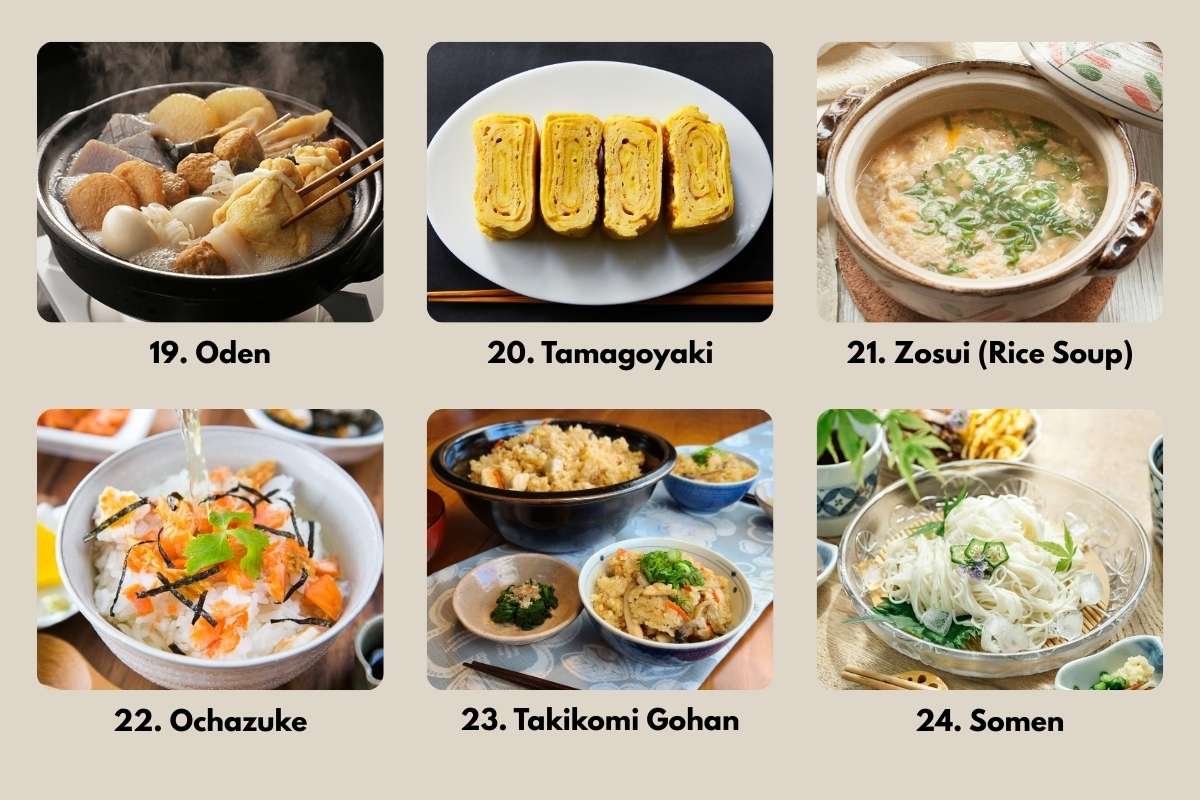
Oden is the definitive Japanese winter stew. It features various ingredients like daikon radish, boiled eggs, and fish cakes simmered in a light, soy-flavored dashi for hours. The daikon becomes so tender that it can be cut with chopsticks, absorbing all the savory depth of the broth.
- Best Place: Konakara (Tokyo) – Known for its artisanal broth.
- Ingredients: Daikon, konnyaku, tofu, and various fish cakes.
- Pro Tip: Don’t drink the broth like soup; use it only to moisten the ingredients.
20. Tamagoyaki
If you look inside any authentic bento box, you will find the Japanese rolled omelet, a fundamental cornerstone of Traditional Japanese Foods. To make it, you roll paper-thin layers of fried egg in a specialized rectangular pan known as a makiyakinabe. Regional tastes dictate whether the chef makes it savory or sweet, but the real challenge remains the same: achieving a perfectly smooth, consistent golden color without a single brown spot.
- Best Place: Tsukiji Outer Market (Tokyo) – Look for the stalls with long lines.
- Ingredients: Eggs, dashi, sugar, and soy sauce.
- Pro Tip: Look for “Dashimaki Tamago” if you prefer a juicier, more savory version.
21. Zosui (Rice Soup)
Zosui is a mild, comforting rice soup often served at the end of a hot pot meal. It uses the leftover broth, enriched by the meats and vegetables cooked earlier, to simmer pre-cooked rice. It’s the ultimate “no-waste” dish that provides a gentle finish to a heavy dinner.
- Best Place: Any high-end Nabe (hot pot) restaurant.
- Ingredients: Rice, leftover dashi broth, egg, and scallions.
- Pro Tip: Wait until the broth has reduced slightly to intensify the flavor before adding the rice.
22. Ochazuke
Ochazuke is the simplest form of comfort. It consists of hot green tea or dashi poured over a bowl of rice topped with savory items like salmon or seaweed. It’s frequently eaten as a quick late-night snack or as a way to settle the stomach after a long night of social drinking.
- Best Place: Tai-chazuke En (Tokyo) – Specializes in sea bream ochazuke.
- Ingredients: Rice, green tea (usually sencha), and toppings like Umeboshi.
- Pro Tip: Try it with Genmaicha (popcorn tea) for a toasted, nutty flavor.
23. Takikomi Gohan
Takikomi Gohan is “seasoned rice,” where the ingredients are cooked with the rice rather than added later. This allows the rice grains to absorb the oils and juices of mushrooms, carrots, and chicken. It is a deeply aromatic dish that changes flavors depending on the season’s harvest.
- Best Place: Traditional Minshuku (family-run guesthouses) in the Japanese Alps.
- Ingredients: Rice, soy sauce, dashi, mushrooms, and burdock root.
- Pro Tip: The best part is the Okage—the slightly burnt, crispy rice at the bottom of the pot.
24. Somen
Somen are the thinnest of all Japanese noodles, made from wheat and stretched until they are hair-fine. They are almost exclusively eaten cold in the summer, served in a glass bowl with ice cubes. They are refreshing, light, and provide immediate relief from the humidity of the Japanese archipelago.
- Best Place: Miwa Somen (Nara) – The birthplace of somen.
- Ingredients: Wheat flour and salted water.
- Pro Tip: Look for “Nagashi Somen,” where the noodles are caught with chopsticks as they slide down a bamboo flume of cold water.
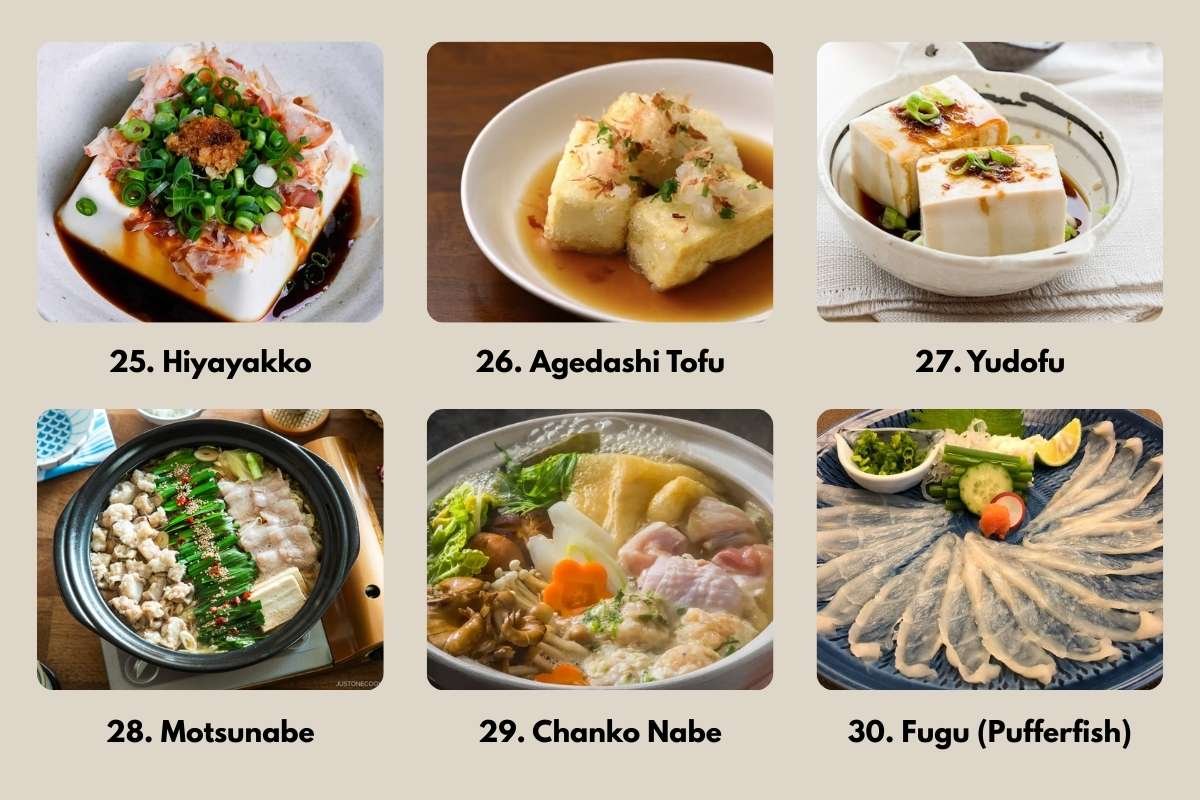
25. Hiyayakko
Hiyayakko is a chilled tofu dish that highlights the quality of the water used to make the tofu. Because the tofu is served raw, its creamy, subtle sweetness is the star. It is an essential side dish in Traditional Japanese Foods, providing a cool contrast to grilled or fried main courses.
- Best Place: Kyoto – Famous for having the softest spring water for tofu making.
- Ingredients: Silken tofu, grated ginger, bonito flakes, and soy sauce.
- Pro Tip: Don’t drown it in soy sauce; a few drops are enough to enhance the tofu.
Read Next: Foods in Mexico: Provide Glimpse Of Rich Culinary Legacy of Mexico
26. Agedashi Tofu
Agedashi Tofu is the warm cousin of Hiyayakko. Cubes of firm tofu are lightly coated in potato starch and deep-fried until the skin is slightly chewy. They are then served in a pool of hot, sweet dashi. The contrast between the crispy exterior and the molten, soft interior is addictive.
- Best Place: Traditional Izakayas (Japanese pubs).
- Ingredients: Tofu, potato starch, dashi, and mirin.
- Pro Tip: Eat it quickly while the coating is still crisp and hasn’t absorbed all the broth.
27. Yudofu
Yudofu is “hot water tofu.” This Kyoto specialty involves simmering high-quality tofu in a pot of water with a single piece of kombu. It is the height of culinary minimalism. The focus is entirely on the texture of the tofu and the subtle umami imparted by the kelp.
- Best Place: Nanzenji Temple area (Kyoto) – Surrounded by beautiful gardens.
- Ingredients: Tofu, kombu, and a dipping sauce made of soy and citrus.
- Pro Tip: Use the specialized wire “tofu ladles” to gently lift the tofu without breaking it.
28. Motsunabe
Motsunabe is a rugged, flavor-packed hot pot originating from Fukuoka. It uses beef or pork offal (motsu) simmered with a massive amount of garlic and garlic chives. It is incredibly rich in collagen, making it a favorite among those looking for a “beauty meal” to improve skin elasticity.
- Best Place: Yamanaka (Fukuoka) – The gold standard for offal hot pot.
- Ingredients: Beef offal, cabbage, garlic chives, and chili peppers.
- Pro Tip: After finishing the meat, add champon noodles to the remaining garlicky broth.
29. Chanko Nabe
This is the food of giants. Chanko Nabe is the staple diet of Sumo wrestlers. It is a massive, protein-heavy stew containing everything from chicken and fish to tofu and vegetables. Despite its reputation for bulk, it is actually a very healthy, balanced meal that builds lean muscle and provides sustained energy.
- Best Place: Ryogoku district (Tokyo) – The center of the Sumo world.
- Ingredients: Chicken, seafood, tofu, bok choy, and dashi.
- Pro Tip: Many restaurants are owned by retired Sumo wrestlers and use their secret family recipes.
30. Fugu (Pufferfish)
Fugu is the world’s most dangerous delicacy. It contains tetrodotoxin, which can be fatal if not removed correctly. Chefs must train for years to earn a license to serve it. The meat itself is lean, firm, and has a very subtle, clean flavor, usually served as translucent sashimi.
- Best Place: Shimonoseki (Yamaguchi Prefecture) – The Fugu capital of Japan.
- Ingredients: Pufferfish and ponzu sauce.
- Pro Tip: Try the “Hire-zake”—hot sake with a grilled pufferfish fin dipped inside for a smoky flavor.
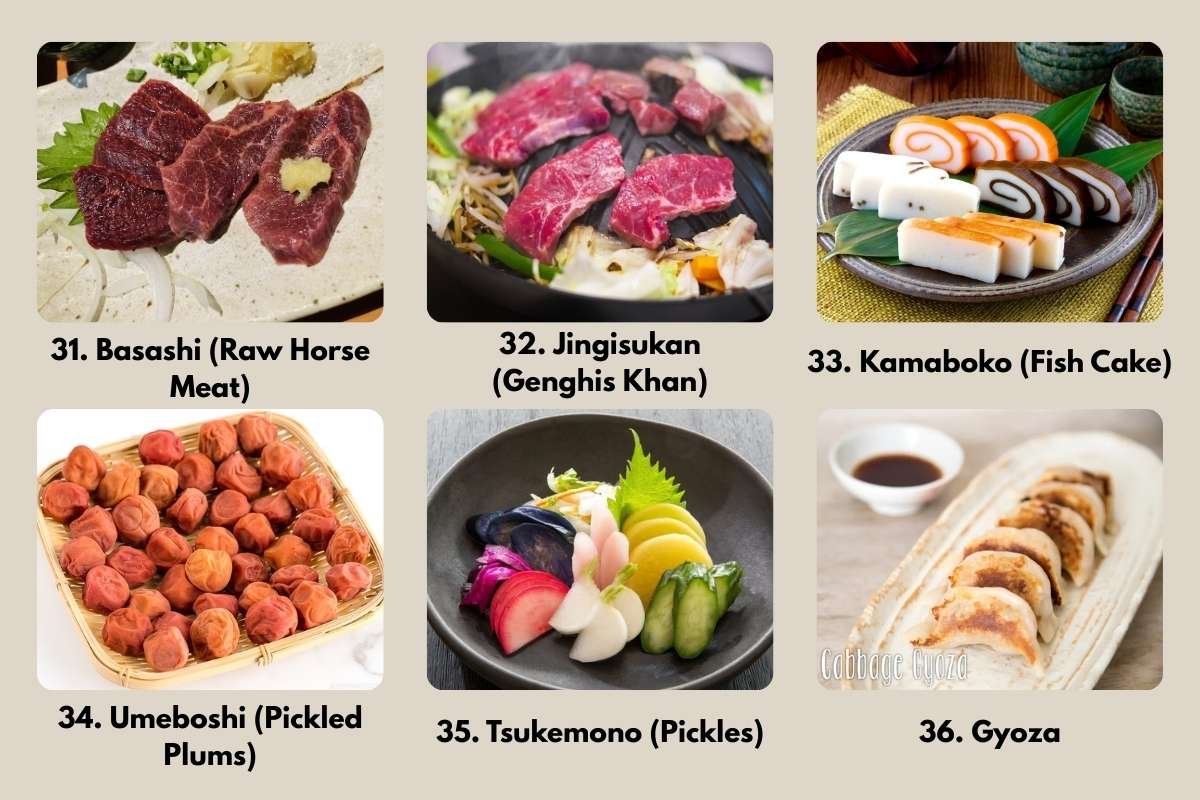
31. Basashi (Raw Horse Meat)
Basashi is a regional specialty of Kumamoto. Known as “Sakura Niku” (Cherry Blossom Meat) because of its bright red color, horse meat is incredibly lean and high in protein. It is served raw and sliced thin, having a flavor similar to high-quality beef but with a much cleaner finish.
- Best Place: Sugimoto (Kumamoto) – Specializes in various cuts of horse meat.
- Ingredients: Raw horse meat, ginger, garlic, and sweet soy sauce.
- Pro Tip: Try the “fatty” neck cut (Mane) for a texture that mimics tuna belly.
32. Jingisukan (Genghis Khan)
Up in the snowy north of Hokkaido, you’ll find one of the most rugged and communal Traditional Japanese Foods known as Jingisukan. It’s a savory mutton or lamb dish grilled right at your table on a distinct, dome-shaped iron skillet. Local legend claims the skillet’s shape represents the helmets once worn by Mongolian soldiers. As the meat sears at the peak of the dome, the delicious juices trickle down to season the ring of cabbage and onions sizzling around the rim.
- Best Place: Sapporo Beer Garden (Hokkaido).
- Ingredients: Lamb or mutton, onions, bell peppers, and a spicy soy dipping sauce.
- Pro Tip: It’s best enjoyed with a cold Hokkaido-brewed beer to balance the gaminess of the meat.
33. Kamaboko (Fish Cake)
Kamaboko is a processed seafood product made by steaming pureed white fish. It is often shaped into a semi-cylinder on a wooden block. While it’s a common topping for noodles, high-quality artisanal kamaboko is a delicacy on its own, valued for its bouncy “mochi-mochi” texture.
- Best Place: Suzuhiro Kamaboko Museum (Odawara).
- Ingredients: White fish (surimi), egg whites, and salt.
- Pro Tip: The wooden block helps control moisture; don’t remove the kamaboko until you are ready to eat.
34. Umeboshi (Pickled Plums)
Umeboshi are the “alkalizing kings” of the Japanese diet. These plums are pickled in salt and shiso leaves, resulting in an incredibly sour and salty profile. They are praised for their ability to aid digestion, prevent fatigue, and act as a natural preservative for rice in bento boxes.
- Best Place: Wakayama Prefecture – Produces the famous Kishu Nanko-ume.
- Ingredients: Ume plums, salt, and red shiso leaves.
- Pro Tip: If the flavor is too intense, look for “Honey Umeboshi” for a sweeter, milder version.
35. Tsukemono (Pickles)
In Japan, no meal is complete without Tsukemono. These aren’t just vinegar pickles; they are often fermented in rice bran (Nuka), miso, or sake lees. They provide the necessary enzymes to help the body process the starches in rice and the proteins in fish.
- Best Place: Nishiki Market (Kyoto) – Often called “Kyoto’s Kitchen.”
- Ingredients: Seasonal vegetables like daikon, cucumber, and eggplant.
- Pro Tip: Try “Narazuke”—pickles fermented in sake lees for years until they turn dark brown.
36. Gyoza
While originally Chinese, the Japanese “Gyoza” has evolved into its own distinct form. Japanese gyoza usually have a thinner skin and a heavier focus on garlic. They are traditionally “Haneda” (winged)—pan-fried on the bottom to a deep crunch while the tops are steamed to softness.
- Best Place: Utsunomiya (Tochigi) – The undisputed Gyoza capital of Japan.
- Ingredients: Pork, cabbage, garlic, ginger, and flour wrappers.
- Pro Tip: The classic dipping sauce is a mix of soy sauce, rice vinegar, and “Rayu” (chili oil).
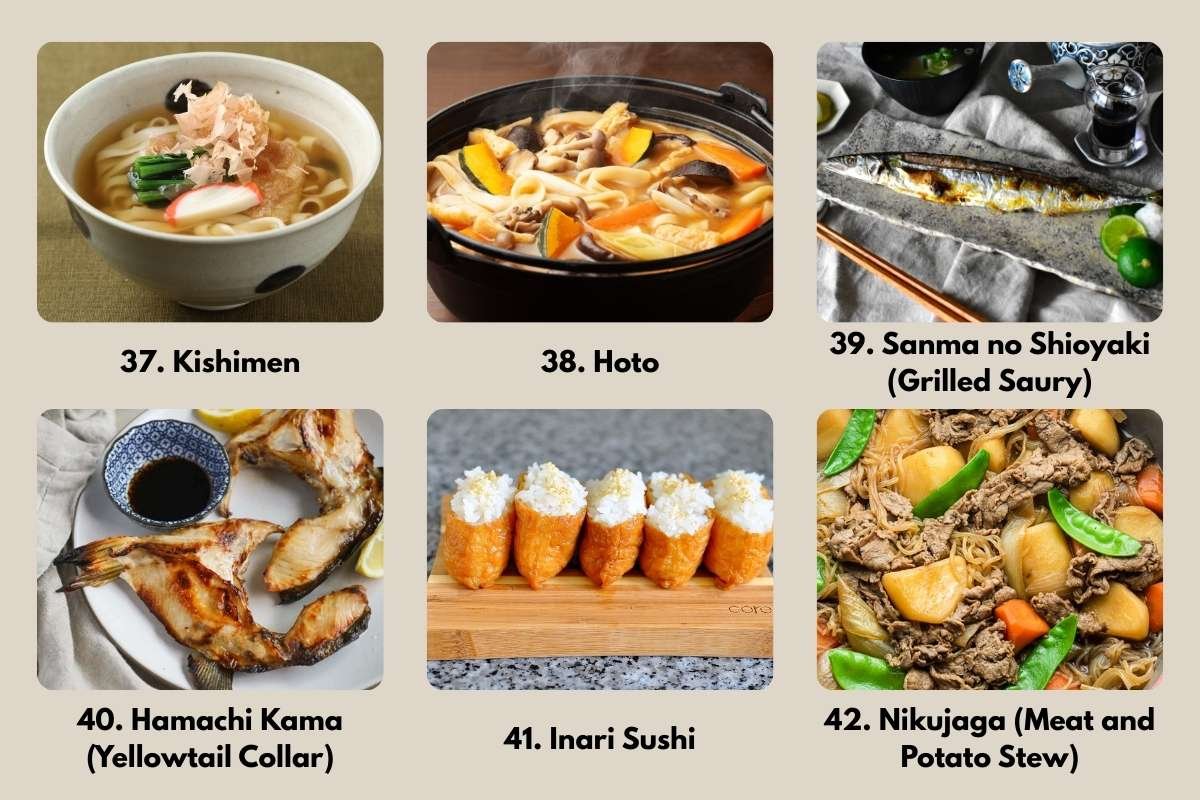
37. Kishimen
Kishimen is Nagoya’s answer to udon. These are broad, flat noodles that have a larger surface area to catch the savory broth. They have a more slippery texture than standard udon and are often served with a generous amount of bonito flakes that “dance” on top of the steam.
- Best Place: Nagoya Station platforms – Surprisingly home to some of the best kishimen.
- Ingredients: Wheat flour, water, and salt.
- Pro Tip: Try the “Miso-nikomi” version for a rich, fermented flavor unique to the region.
38. Hoto
Hoto is a hearty, flat-noodle stew from the mountains of Yamanashi. Unlike udon, the noodles are not pre-boiled; they are cooked directly in a miso-based soup with pumpkin and other root vegetables. This creates a thick, gravy-like broth that is incredibly warming in the winter months.
- Best Place: Kosaku (Yamanashi) – A famous chain serving Hoto in iron pots.
- Ingredients: Flat wheat noodles, pumpkin (kabocha), and miso.
- Pro Tip: Eat it slowly; the pumpkin breaks down into the broth, making it tastier as you go.
39. Sanma no Shioyaki (Grilled Saury)
Sanma is the “flavor of autumn.” This long, silver fish is simply rubbed with sea salt and grilled whole. The guts are left inside, as their bitterness is highly prized by adults when paired with the sweetness of the white flesh and a squeeze of sudachi citrus.
- Best Place: Meguro Sanma Festival (Tokyo) in September.
- Ingredients: Pacific saury, salt, and daikon oroshi (grated radish).
- Pro Tip: The skin should be blistered and crispy; eat the skin and flesh together for the best experience.
40. Hamachi Kama (Yellowtail Collar)
Ask any local connoisseur, and they’ll tell you: the “Kama,” or the collar found right behind the gills, is actually the prize cut of the fish. As one of the more underrated Traditional Japanese Foods, it’s a masterclass in texture. Once it hits the grill, the skin turns into a salty, crackling-crisp shell that protects the rich, fatty meat underneath. It’s far more succulent than the standard fillet, offering a melt-in-your-mouth experience that casual diners often overlook.
- Best Place: Coastal towns in Toyama Prefecture.
- Ingredients: Yellowtail collar, salt, and lemon.
- Pro Tip: Don’t be afraid to use your hands to get the small, tender morsels of meat hidden near the bone.
41. Inari Sushi
Named after the Shinto god Inari, whose messengers (foxes) are said to love fried tofu. This dish consists of vinegared rice stuffed into pouches of “Aburaage” (deep-fried tofu) that have been simmered in a sweet soy liquid. It’s a favorite in bento boxes and for picnics.
- Best Place: Fushimi Inari Shrine (Kyoto) – Stalls near the shrine are legendary.
- Ingredients: Aburaage, sushi rice, soy sauce, and sugar.
- Pro Tip: Look for regional variations; in Western Japan, they are often triangular.
42. Nikujaga (Meat and Potato Stew)
Nikujaga is the ultimate “mother’s cooking” (Ofukuro no aji). It is a simple stew of meat, potatoes, and carrots. It was reportedly created by the Japanese Navy in the late 19th century as a variation of British beef stew but flavored with traditional Japanese seasonings.
- Best Place: Any Teishoku (set meal) restaurant.
- Ingredients: Beef or pork, potatoes, onions, soy sauce, and mirin.
- Pro Tip: The potatoes should be slightly “fluffy” on the edges, indicating they’ve absorbed the sauce.
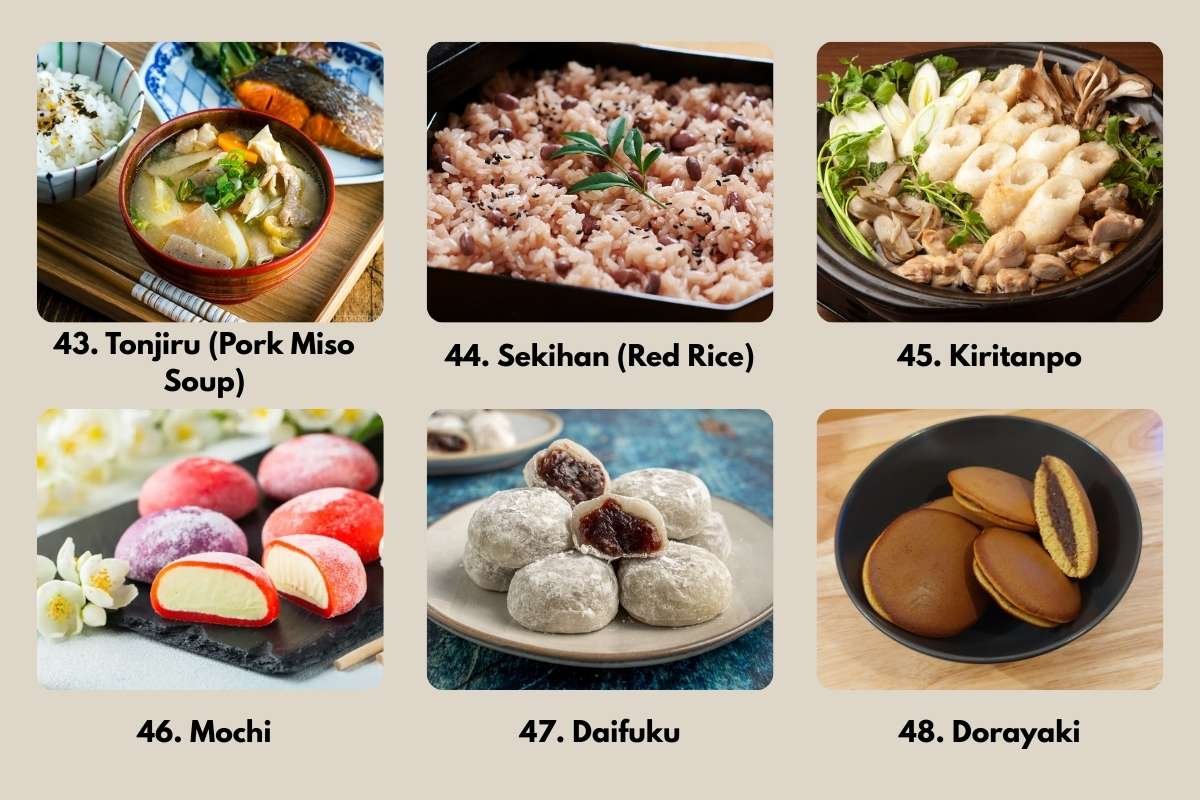
43. Tonjiru (Pork Miso Soup)
Tonjiru is a more robust version of miso soup. It contains thin slices of pork belly and root vegetables like burdock and taro. The pork fat creates a layer on top of the soup that keeps it piping hot, making it a favorite for outdoor festivals in the cold.
- Best Place: Ski resorts in Nagano or Hokkaido.
- Ingredients: Pork belly, miso, burdock root, carrots, and konnyaku.
- Pro Tip: Add a sprinkle of “Shichimi Togarashi” (seven-spice powder) for extra warmth.
44. Sekihan (Red Rice)
Sekihan is the food of celebration. It is glutinous rice steamed with adzuki beans, which dyes the rice a festive red color. It is traditionally served at weddings, birthdays, and the birth of a child. It has a chewy texture and a very subtle nuttiness.
- Best Place: Home-cooked meals or high-end Kaiseki restaurants.
- Ingredients: Mochi rice (glutinous), adzuki beans, and black sesame seeds.
- Pro Tip: It’s usually served at room temperature and is surprisingly filling.
45. Kiritanpo
An Akita specialty, Kiritanpo is cooked rice that is mashed, formed into cylinders around cedar skewers, and toasted over a hearth. It can be eaten with miso paste or cut up and put into a chicken-based hot pot. It’s a rustic, satisfying dish with a wonderful charred aroma.
- Best Place: Akita Prefecture during the winter.
- Ingredients: Mashed rice and cedar skewers.
- Pro Tip: Try it in “Kiritanpo Nabe,” which uses Hinai-jidori (a premium local chicken).
46. Mochi
Long before modern energy bars existed, there was Mochi, an ancient power food and a heavy hitter among Traditional Japanese Foods. Creating it is a true feat of physical labor; you have to pound steamed glutinous rice with massive wooden mallets until it transforms into a thick, elastic paste. While you’ll find it served in dozens of ways throughout the year, it carries the most weight during New Year celebrations, where every bite symbolizes a prayer for health and a long, resilient life.
- Best Place: Nara (Nakatanidou) – Famous for its high-speed mochi pounding.
- Ingredients: Glutinous rice and water.
- Pro Tip: Eat in small bites; mochi is notoriously sticky and can be a choking hazard if swallowed whole.
47. Daifuku
Daifuku literally means “Great Luck.” It is a small, round mochi stuffed with a sweet center, usually “Anko” (red bean paste). The soft, powdery skin and the dense, sweet filling make it the quintessential Japanese afternoon snack to be enjoyed with bitter green tea.
- Best Place: Gungetsu (Tokyo) – Known for their artisanal beans.
- Ingredients: Mochi and sweetened adzuki bean paste.
- Pro Tip: Try “Ichigo Daifuku,” which contains a whole fresh strawberry inside for a tart contrast.
48. Dorayaki
Dorayaki consists of two small, sponge-like pancakes made of Castella cake wrapped around a filling of sweet red bean paste. It is famously the favorite food of the cartoon character Doraemon. The pancakes are soft and honey-scented, making them a hit with both children and adults.
- Best Place: Usagiya (Ueno, Tokyo) – People line up for these while they’re still warm.
- Ingredients: Flour, eggs, honey, and adzuki bean paste.
- Pro Tip: Look for the ones with “Tsubuan” (chunky bean paste) for better texture.
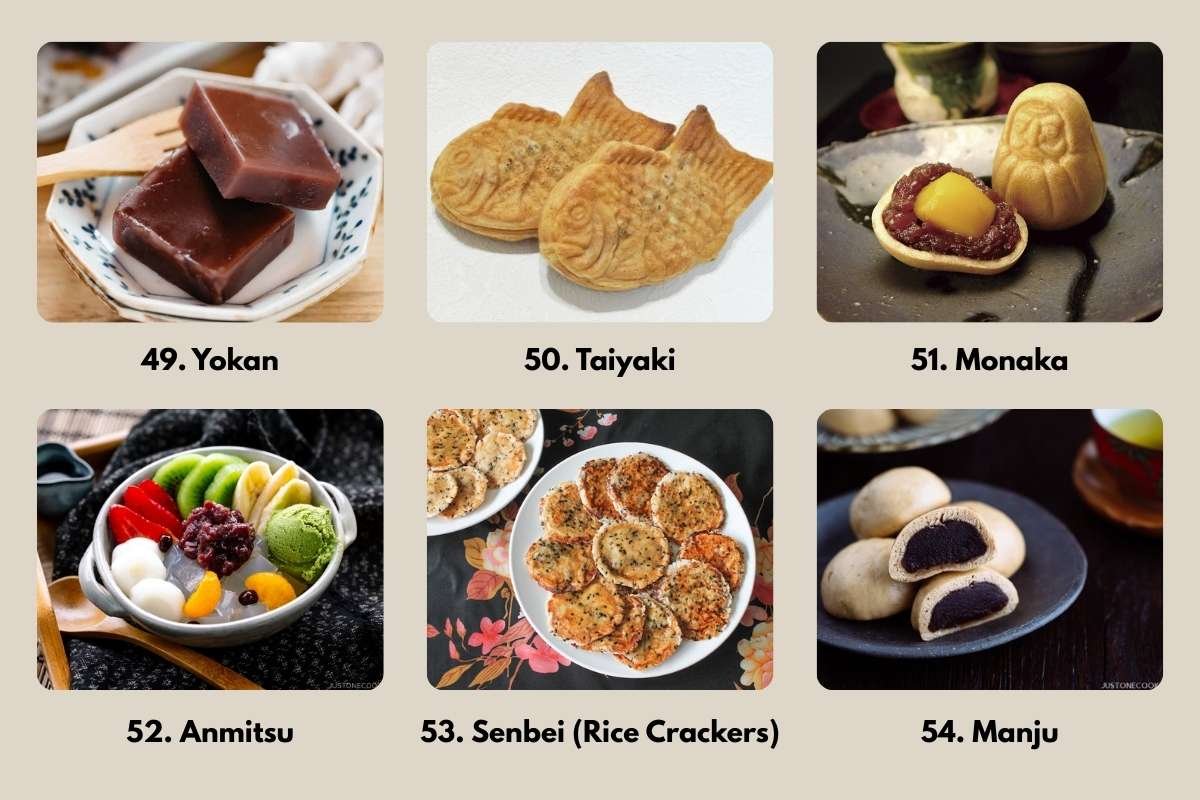
49. Yokan
Yokan is a traditional “Wagashi” (sweet) made of red bean paste, agar, and sugar. It is sold in blocks and sliced thin. Because it is highly concentrated, it has a long shelf life and was traditionally carried by travelers as a high-energy snack.
- Best Place: Toraya (Tokyo/Kyoto) – A confectioner to the Imperial family since the 16th century.
- Ingredients: Adzuki beans, agar-agar, and sugar.
- Pro Tip: It pairs perfectly with high-grade Matcha; the sugar balances the tea’s bitterness.
50. Taiyaki
Taiyaki is a fish-shaped cake that mimics the “Tai” (sea bream), a fish associated with good fortune. The batter is poured into a fish-shaped mold and filled with red bean paste, custard, or chocolate. The best taiyaki have a thin, crispy tail that is full of filling.
- Best Place: Naniwaya Sohonten (Azabu-Juban, Tokyo) – The original creator of taiyaki.
- Ingredients: Flour batter and various fillings.
- Pro Tip: There is an ongoing debate in Japan about whether to start eating from the head or the tail—try both!
51. Monaka
In the world of Traditional Japanese Foods, few treats play with texture as elegantly as Monaka. These sweets consist of a dense, jam-like bean filling “sandwiched” between two thin, crisp wafers crafted from mochi flour. The magic is in the contrast: the wafers are so light they practically vanish on your tongue, leaving behind the rich, earthy sweetness of the bean paste.
- Best Place: Kuya (Ginza, Tokyo) – Their monaka are so popular that they require reservations.
- Ingredients: Mochi flour wafers and adzuki bean jam.
- Pro Tip: Some modern versions include a layer of cream or even ice cream.
52. Anmitsu
Anmitsu is a traditional dessert bowl. It features cubes of agar jelly (made from seaweed), sweet red bean paste, boiled peas, and various fruits. It is topped with a heavy drizzle of “Kuromitsu” (black sugar syrup), creating a refreshing and multi-textured treat.
- Best Place: Wakamatsu (Ginza, Tokyo) – The birthplace of the modern anmitsu.
- Ingredients: Agar, adzuki beans, fruit, and black syrup.
- Pro Tip: Add a scoop of matcha ice cream to make it a “Cream Anmitsu.”
53. Senbei (Rice Crackers)
Senbei are the “chips” of Japan, but much healthier. These rice crackers are usually toasted over a flame and brushed with a savory soy sauce glaze. They range from small and sweet to large, hard crackers that require significant jaw strength to break.
- Best Place: Soka (Saitama Prefecture) – The home of the traditional soy-sauce senbei.
- Ingredients: Rice and soy sauce.
- Pro Tip: Look for “Nure-senbei” (wet senbei) if you prefer a chewy, soy-soaked texture.
54. Manju
Manju are steamed buns made from a dough of flour, rice powder, and sometimes buckwheat. They are almost always filled with sweet bean paste. They are a common souvenir at hot spring (onsen) towns, where they are often steamed using the natural heat of the volcanic vents.
- Best Place: Onsen towns like Arima or Kusatsu.
- Ingredients: Flour, dough, and adzuki beans.
- Pro Tip: Enjoy them while they are still steaming hot for the softest texture.
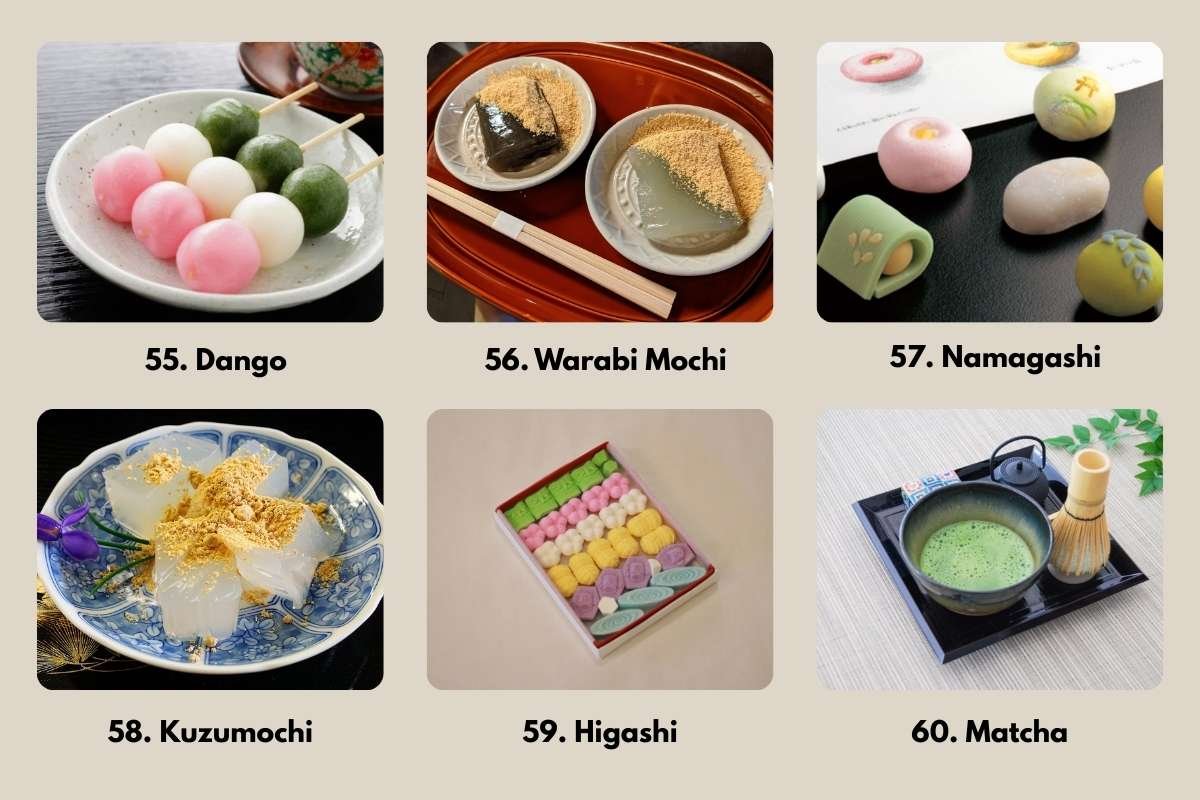
55. Dango
Dango are small, round dumplings made from rice flour, served three to five on a skewer. The most famous is “Hanami Dango,” with pink, white, and green balls representing the cherry blossom season. Another favorite is “Mitarashi Dango,” covered in a sweet and salty soy glaze.
- Best Place: Kamo Mitarashi Chaya (Kyoto) – Located near the Shimogamo Shrine.
- Ingredients: Rice flour (mochiko) and water.
- Pro Tip: In Kyoto, look for the burnt spots on the dango; they indicate it was grilled over real charcoal.
Read Next: 10 Powerful Immune-Boosting Foods to Keep You Healthy
56. Warabi Mochi
Unlike regular mochi made from rice, Warabi Mochi is made from bracken starch. It has a jelly-like, translucent appearance and a cooling, slippery texture. It is traditionally dusted in “Kinako” (toasted soybean flour) and served as a cooling summer dessert in Kyoto.
- Best Place: Kyoto Gion area.
- Ingredients: Bracken starch, kinako, and sugar.
- Pro Tip: It is best eaten cold with a drizzle of black sugar syrup.
57. Namagashi
Namagashi are the “living sweets” of the tea ceremony. These are unbaked, highly artistic confections made of flour and bean paste. They are meticulously shaped to look like seasonal flowers, leaves, or even weather patterns, designed to be consumed in just a few bites.
- Best Place: Toraya Kyoto Gallery.
- Ingredients: Rice flour and adzuki bean paste.
- Pro Tip: Namagashi are meant to be eaten before drinking the tea to prepare the palate for the tea’s bitterness.
58. Kuzumochi
Kuzu is made from the starch of the Kuzu root or fermented wheat starch. It has a firm, slightly chewy texture and is usually cut into triangles. It is a humble, ancient sweet that is prized for its “cleansing” properties in traditional Japanese medicine.
- Best Place: Funabashiya (Kameido, Tokyo) – Serving this since 1805.
- Ingredients: Fermented starch, kinako, and kuromitsu syrup.
- Pro Tip: The fermentation gives it a very subtle, unique tang that pairs well with the sweet syrup.
59. Higashi
Higashi are “dry” sweets made by pressing a mixture of fine sugar and rice flour into wooden molds. They are colorful, intricate, and have a very long shelf life. They are primarily served at formal tea ceremonies due to their elegant appearance and subtle sweetness.
- Best Place: Kanazawa (Ishikawa Prefecture) – A city famous for high-end tea culture.
- Ingredients: Wasanbon sugar and rice flour.
- Pro Tip: Let the sweet dissolve on your tongue rather than chewing it.
60. Matcha
The ultimate Traditional Japanese Foods list must end with Matcha. This is not just green tea; it is a finely ground powder of specially grown shade-grown leaves. It is high in L-theanine, which provides a “calm alertness.” Preparing and drinking it is a meditative act that remains the heart of Japanese hospitality.
- Best Place: Uji (Kyoto) – The world’s premier matcha-growing region.
- Ingredients: Ground green tea leaves and hot water.
- Pro Tip: Use a bamboo whisk (Chasen) to create a thick, frothy foam on top.
Conclusion (Warm, Reflective, Full Circle)
I still remember that pause after the first bite. The quiet moment where I wasn’t sure what I was feeling yet, only that it was different. Not love at first taste, but something gentler. Curiosity. Respect. Recognition.
That’s the magic of Traditional Japanese Foods.
They don’t rush you. They teach you how to pay attention. Over time, you start noticing things you once ignored, like the temperature, texture, balance, and even timing. Food stops being about boldness and starts being about care.
Much like a film that reveals its meaning only after you sit with it, Japanese cuisine invites reflection. Every dish in this list—whether humble street food or refined kaiseki—carries the same quiet belief: that simplicity, when done with intention, is never empty.
Once you experience Traditional Japanese Foods this way, eating changes. Not dramatically. Just deeply. And after that, it’s hard to go back to food that only tries to be loud.



Comments
Post a Comment