Struggling to Lead? These 4 Pillars of Leadership Change Everything

The “command and control” approach of the past has become outdated in a time of constant disruption. To navigate global uncertainty and achieve remarkable results. True leadership is now the art of organizing collective intelligence rather than holding a position of authority. Leaders must establish a foundation that strikes a balance between adaptability and unwavering integrity to prosper in this unstable environment.
Presenting the 4 Pillars of Leadership: a strategic plan for long-term, powerful influence. This framework converts intangible objectives into quantifiable success and is based on Trust, Vision, Accountability, and Empowerment. You can develop a resilient culture that encourages innovation internationally by grasping these fundamental principles.
What Are the 4 Pillars of Leadership?
The “4 Pillars of Leadership” is an essential framework that elite organizations use to convert individual authority into collective impact rather than a single strict rule. These pillars specify what a leader does to maintain high performance in a globalized, unstable market, whereas generic lists concentrate on what a leader is.
Different high-authority frameworks prioritize different capabilities depending on their focus:
- Growth-Oriented (LEAD): Learn, Execute, Adapt, and Develop. This model focuses on continuous improvement and the agility to pivot during disruption.
- People-Centric: Self-Awareness, Accountability, Relationship Building, and Empowerment. This framework (often cited by Dale Carnegie and EQ experts) prioritizes emotional intelligence as the engine of influence.
- Team Dynamics (The Lencioni-inspired Model): Earned Trust, Healthy Conflict, Mutual Accountability, and Shared Results. This focuses on the health of the unit, moving away from “top-down” command to “peer-to-peer” responsibility.
The 4 Pillars are the key structural pillars that enable a leader to stay upright under the weight of global responsibility. These pillars typically include Character, Vision, Relational Intelligence, and Execution. You can become a catalyst for long-term success and exceed the “boss” title by mastering these.
Here are the Detailed Insights about the 4 Pillars of Leadership:
To lead effectively in the 21st century, one must move beyond the title and master the core architectural foundations that support high-performing teams and global innovation.
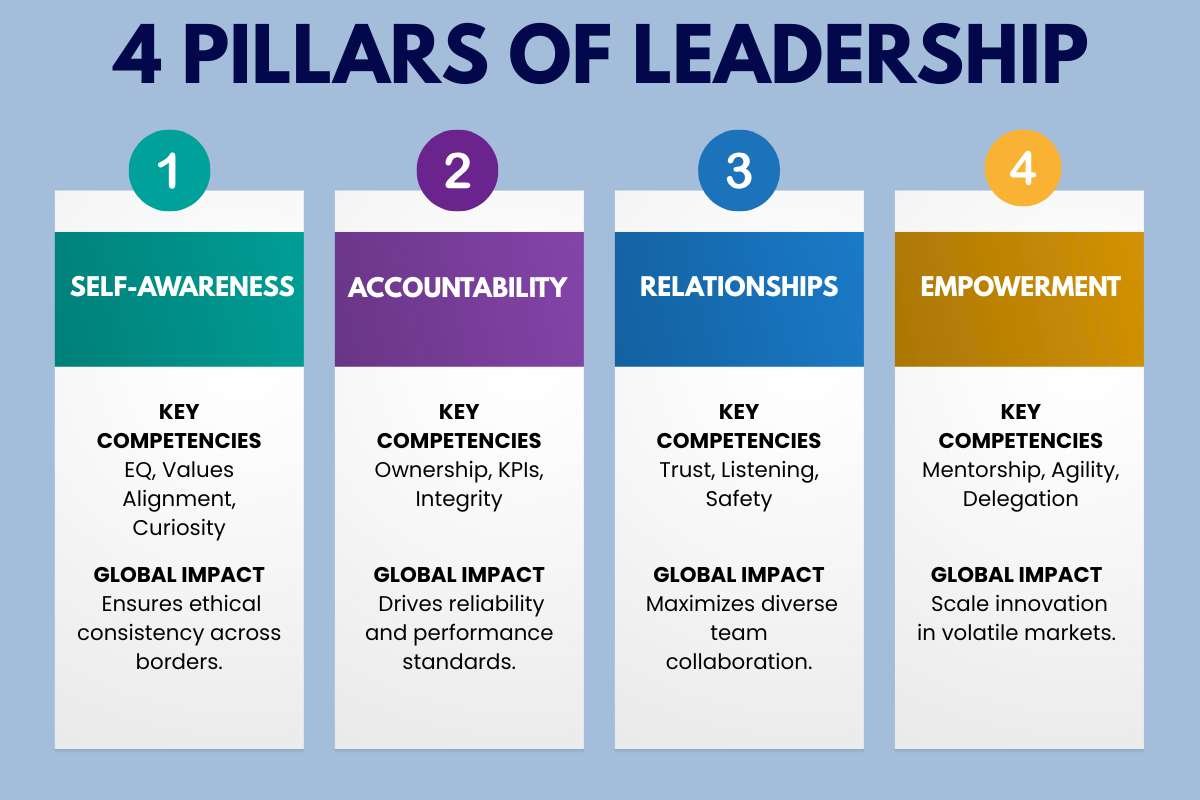
| Pillar | Key Competencies | Global Impact |
| 1. Self-Awareness | EQ, Values Alignment, Curiosity | Ensures ethical consistency across borders. |
| 2. Accountability | Ownership, KPIs, Integrity | Drives reliability and performance standards. |
| 3. Relationships | Trust, Listening, Safety | Maximizes diverse team collaboration. |
| 4. Empowerment | Mentorship, Agility, Delegation | Scale innovation in volatile markets. |
Pillar 1 – Self-Awareness & Continuous Learning

Leadership begins with internal mastery. Self-awareness allows you to recognize strengths and emotional triggers, ensuring your actions are intentional rather than impulsive. By aligning daily behavior with a core “moral compass,” you build a leadership style that resonates across diverse global cultures.
Continuous learning is the natural extension of this awareness. In a volatile world, curiosity is a strategic asset. Leaders with a growth mindset leverage Emotional Intelligence (EQ) to seek feedback and transform challenges into data for improvement.
Mindfulness & Reflection Practices
Modern leaders often utilize “Strategic Pauses.” Brief periods of reflection or mindfulness to detach from the noise and evaluate their decision-making processes.
Learning Methods for Modern Leaders
- Reverse Mentoring: Learning from younger employees about emerging trends.
- Feedback Loops: Implementing “360-degree reviews” to identify blind spots.
Pillar 2 – Accountability & Strategic Execution

As one of the essential 4 pillars of leadership, Accountability acts as the bridge between vision and reality. It requires the discipline to own outcomes. Successes and failures alike, without shifting blame. When leaders “walk the talk,” they build a culture of integrity and transparency, ensuring that performance standards apply to everyone and fostering deep-seated trust across all ranks.
This foundation allows for Strategic Execution, which transforms static plans into dynamic success stories by translating goals into measurable results.
- Satya Nadella (Microsoft): Shifted culture from “know-it-all” to “learn-it-all,” emphasizing accountability for growth.
- Jacinda Ardern (NZ): Utilized transparent execution and clear ownership to align a nation during crises.
KPIs & Performance Ownership
Effective execution requires Key Performance Indicators (KPIs) that are transparent and co-created. This ensures that every team member understands their specific contribution to the “big picture.”
Pillar 3 – Relationship & Trust Building

Leadership is a social endeavor, not a solitary pursuit of power. As the primary currency of influence, Trust prevents communication breakdowns and fuels innovation. Leaders cultivate this by practicing active listening and fostering psychological safety, ensuring team members feel secure enough to take risks and voice dissent.
In a globalized workforce, high cultural intelligence is essential for navigating diverse communication styles. By replacing “polite silence” with healthy conflict, leaders spark the rigorous debate necessary for breakthrough ideas.
Trust as a Leadership Currency
Trust is built in drops but lost in buckets. Consistently demonstrating empathy and competence ensures that your “trust reservoir” remains full during lean times.
Pillar 4 – Empowerment & Adaptive Growth

True leadership isn’t measured by your number of followers, but by the leaders you develop. By shifting from gatekeeper to enabler, you multiply your impact and ensure organizational longevity. It is a core objective of the four pillars of leadership. Empowerment, which involves granting the authority, resources, and mentorship others need, is the key to this transition.
In a VUCA (Volatile, Uncertain, Complex, and Ambiguous) world, this agility is non-negotiable. Adaptive growth allows teams to pivot during market or technological disruptions without waiting for top-down permission. Within the framework of the 4 pillars of leadership, empowered teams respond to challenges in real-time, turning volatility into a competitive advantage.
Delegation & Mentorship
True empowerment isn’t just “dumping” tasks; it is a structured hand-off of responsibility coupled with a safety net of mentorship to ensure the individual grows through the challenge.
Real-World Applications & Examples:
Real-world success proves that these pillars are not just theoretical. They are the engines of global industry leaders.
- Pillars 1 & 2 (Self-Awareness & Execution): Satya Nadella revitalized Microsoft by replacing a “know-it-all” culture with a “learn-it-all” growth mindset. By combining this personal humility with clear strategic accountability for cloud and AI. He drove the company to a multi-trillion-dollar valuation.
- Pillar 3 (Trust Building): Airbnb navigates a global marketplace by prioritizing “belonging” and psychological safety. Their “Elephants, Dead Fish, and Vomit” meeting format encourages radical transparency, helping multicultural teams resolve underlying conflicts quickly to maintain trust.
- Pillar 4 (Empowerment & Adaptation): Netflix operates on a “Context, Not Control” model. By empowering “informed captains” to make high-stakes decisions without top-down approval, the company remains agile enough to pivot from DVD rentals to global streaming and original content production.
Conclusion
More than just a career achievement, mastering the 4 pillars of leadership is a commitment to changing with the times. You can overcome the constraints of conventional management and leave a legacy of strong, productive teams by basing your influence on self-awareness, accountability, trust, and empowerment. The structural integrity required to pivot precisely and lead with purpose is provided by these pillars. You will become a true architect of human potential and global innovation as you apply these competencies in your everyday work.
FAQ:
1. Why are the 4 Pillars of Leadership important in today’s world?
In a fast-changing global environment, leaders face uncertainty, remote teams, and cultural diversity. The four Pillars of Leadership provide a structured framework to remain resilient, build trust, and make informed decisions. They ensure leadership effectiveness is not dependent on authority alone but on values, competence, and people-centric thinking.
2. Are the 4 Pillars of Leadership the same across all industries?
Yes, the core principles of the 4 Pillars of Leadership remain consistent across industries, but their application varies. For example, accountability may focus on safety and compliance in healthcare, while in technology it may emphasize innovation, speed, and delivery. The pillars are universal, yet flexible enough to adapt to different sectors.
3. How do the 4 Pillars of Leadership apply to remote and hybrid teams?
In remote and hybrid work environments, the 4 Pillars of Leadership become even more critical. Self-awareness improves communication, accountability ensures clarity of goals, relationship-building maintains team cohesion, and empowerment encourages autonomy. These pillars help leaders manage performance without micromanagement.




Comments
Post a Comment